How do we make energy security/resilience investable?
Linking energy resilience to reduced costs, new flexibility revenues, improved asset performance, business continuity, and long-term value.


Energy resilience has moved from the margins of energy strategy to the centre of business risk.
Volatile prices, grid constraints, extreme weather, electrification, and geopolitical disruption are changing the way organisations need to think about energy. What was once treated largely as an operating cost is increasingly connected to budgeting, asset performance, business continuity, and long-term planning.
Making energy resilience investable means translating energy risks into measurable commercial outcomes – including avoided costs, improved business continuity, flexibility revenues, and long-term asset performance. Reliable energy data provides the foundation for evaluating these benefits and building a credible investment case.
At EnergyElephant, our work with organisations managing increasingly complex energy estates points to one recurring theme – resilience becomes much easier to act on when the underlying utilities and carbon data is reliable, accessible, and decision-ready.
That creates a more difficult question than simply asking how to become more resilient.
The real question is – how do we make energy resilience and security investable?
For Finance teams, that means being able to quantify exposure and avoided cost. For Operations and Estates teams, it means understanding which sites, loads, and assets matter most. For Sustainability teams, it means connecting resilience with decarbonisation, flexibility, and climate adaptation.
And all of those decisions depend on the same foundation – reliable data.
Why Does Energy Resilience Start With Reliable Data?
Energy resilience starts with reliable data because organisations need to understand their consumption patterns, critical loads, and operational risks before determining which technologies or infrastructure investments will deliver the greatest value.
The temptation is to start with technology. Batteries, onsite generation, smart controls, backup systems, and demand-response technologies all have an important role to play. But they are not the starting point.
The starting point is visibility.
Before deciding where to invest, organisations need to understand how energy actually behaves across their estate.
Which sites experience the highest peaks? Which loads are genuinely critical? Where can consumption move? What happens to costs during volatile periods? Which assets can respond when grid or market conditions change?
Without that level of understanding, resilience remains difficult to quantify – and what cannot be quantified is difficult to fund.
This is why resilience is as much an information challenge as it is an infrastructure challenge.
How to Build a Business Case for Energy Resilience
A credible business case for energy resilience must account for more than reduced energy consumption. It should demonstrate how proposed investments can reduce financial exposure, minimise operational disruption, improve asset performance, and potentially create new revenue opportunities.
Traditionally, energy-efficiency projects have been assessed through a familiar formula – invest capital, reduce consumption, calculate savings, and estimate payback.
Resilience is broader.
Its value may sit in avoided disruption, lower exposure to peak charges, reduced sensitivity to volatile prices, greater predictability in future budgets, or a lower dependence on emergency energy procurement.
Some investments can create additional value too. Flexible assets may participate in demand-side response, potentially generating additional revenue. Energy storage can reduce peak demand, provide backup capability, and support onsite generation. Controllable loads can be shifted away from expensive or constrained periods.
The result is a business case that is not simply about using fewer kilowatt-hours.
It's about cost avoidance, flexibility, asset performance, continuity, and risk reduction.
That changes the way resilience should be viewed. Rather than thinking of it as a single technology purchase, organisations should increasingly think in terms of a portfolio of capabilities – and use data to determine which combination makes commercial sense.
How Can Organisations Measure the Value of Energy Resilience?
Organisations can measure the commercial value of energy resilience by tracking outcomes such as avoided peak demand, reduced exposure to energy price volatility, flexibility revenues, improved operational continuity, and changes in forecast energy costs.
Better data is what turns this from theory into something measurable.
Granular energy information can reveal peak-demand patterns, abnormal consumption, capacity constraints, and operational stress points. Once those patterns become visible, organisations can begin to determine which demand is essential, which can move, and which assets can respond when circumstances change.
That creates a much stronger basis for investment decisions.
Instead of simply stating that an organisation has "invested in resilience", leaders can ask more useful questions:
- How much peak demand have we avoided?
- How much exposure to price volatility have we reduced?
- What flexibility revenue have we generated?
- How effectively can our sites respond to a grid event?
- How has an intervention changed forecast energy costs?
These are the kinds of questions that help turn resilience from an abstract objective into an operational discipline.
They also provide Finance, Operations, Estates, and Sustainability teams with a shared set of measurable outcomes against which to evaluate investment decisions.
Why is Fragmented Energy Data a Barrier to Resilience Planning?
Fragmented energy data makes it difficult for organisations to establish credible baselines, identify operational risks, forecast investment returns, and demonstrate the effectiveness of resilience measures.
Many organisations already have large amounts of energy data, but still lack a coherent view of their energy position.
Information may be scattered across supplier invoices, spreadsheets, building management systems, smart meters, procurement databases, and sustainability tools.
Records may contain gaps, estimates, duplicated bills, or inconsistent formats. The issue is often not a shortage of data, but a lack of confidence in it.
That matters because credible resilience strategies depend on credible baselines.
If an organisation cannot trust the information it is using, it becomes harder to identify where investment is justified, forecast the likely return, or demonstrate whether an intervention delivered what was expected.
Reliable, consolidated energy data provides the foundation for making these decisions with greater confidence.
Where Should Organisations Start Investing in Energy Resilience?
The most effective starting point for energy resilience investment is to establish reliable visibility across the organisation's energy estate, strengthen active energy management, and then evaluate more advanced resilience measures.
This suggests a simple but important sequence:
1. Create reliable visibility. Establish a trustworthy understanding of energy consumption, costs, peak demand, and operational risks across sites and assets.
2. Improve active energy management. Use that information to identify inefficiencies, manage demand, and improve operational performance.
3. Invest in advanced resilience capabilities. Evaluate technologies such as storage, onsite generation, demand flexibility, and smart controls against measurable business requirements.
This approach allows organisations to make investment decisions based on evidence rather than assumptions.
The first resilience investment, therefore, may not be a battery.
It may be confidence in the data used to decide whether a battery is needed at all.
How Do Energy Resilience & Decarbonisation Work Together?
Energy resilience and decarbonisation are complementary objectives. Measures that improve energy efficiency, optimise demand, and increase the effective use of renewable generation can simultaneously reduce emissions, control costs, and strengthen operational resilience.
That becomes increasingly important as the energy transition accelerates.
As electricity plays a greater role in buildings, transport, heating, and industry, organisations can become more exposed to the reliability, capacity, and price dynamics of electricity networks.
That does not weaken the case for decarbonisation. It strengthens the case for building resilience into it.
A resilient energy strategy considers efficiency, flexible demand, generation, storage, and operational controls together.
The objective is not simply to use less energy, but to understand when energy is used, where it is used, which demand can move, and how the organisation can respond when conditions change.
That creates an important alignment between cost, carbon, and continuity.
Efficiency reduces emissions while also reducing the amount of energy that needs to be secured. Load shifting can cut costs and reduce pressure during constrained periods. Storage can reduce peaks and support greater use of onsite renewables.
The more intelligently these measures are co-ordinated, the less resilience and sustainability look like separate agendas.
Turning Energy Resilience into Long-term Business Value
The long-term business value of energy resilience lies in an organisation's ability to anticipate energy risks, respond effectively to changing conditions, and demonstrate measurable financial and operational benefits from its investments.
Major outages are the most visible expression of energy risk, but for most organisations resilience will be tested in less dramatic ways – price spikes, capacity constraints, extreme weather, changing operating patterns, and increasingly complex energy markets.
The organisations best placed to navigate those conditions will not necessarily be those with the most technology.
They will be those that understand what is happening across their energy estate, identify risk early, evaluate different responses, and measure whether their investments are delivering value.
That is ultimately what makes resilience investable.
Quality data turns uncertainty into something that can be understood, modelled, and acted upon.
Once resilience can be expressed in terms of avoided costs, improved asset performance, flexibility revenues, operational continuity, and long-term value, it becomes much easier to build a credible business case for action.
The opportunity is not simply to make organisations more resilient. It is to make resilience a measurable, commercially justified part of long-term energy and sustainability strategy.
Of course, recognising the value of an investment and securing approval for it are two different things. Whether you're looking to improve energy data visibility, strengthen operational efficiency, or build a more resilient energy strategy, a compelling business case is essential for demonstrating the financial and operational benefits to decision-makers.
Ready to make the case for investment? Download our complimentary Business Case Template to help turn your proposal into a clear, commercially grounded argument for action.
About EnergyElephant
EnergyElephant is an energy and sustainability software company providing an integrated platform for managing and reporting energy, water, waste, costs, and carbon emissions across buildings, vehicles, and other assets worldwide. Thousands of users in more than 80 countries have managed over €3 billion in energy, utilities, and sustainability spend to date.
EnergyElephant at EMEX 2026
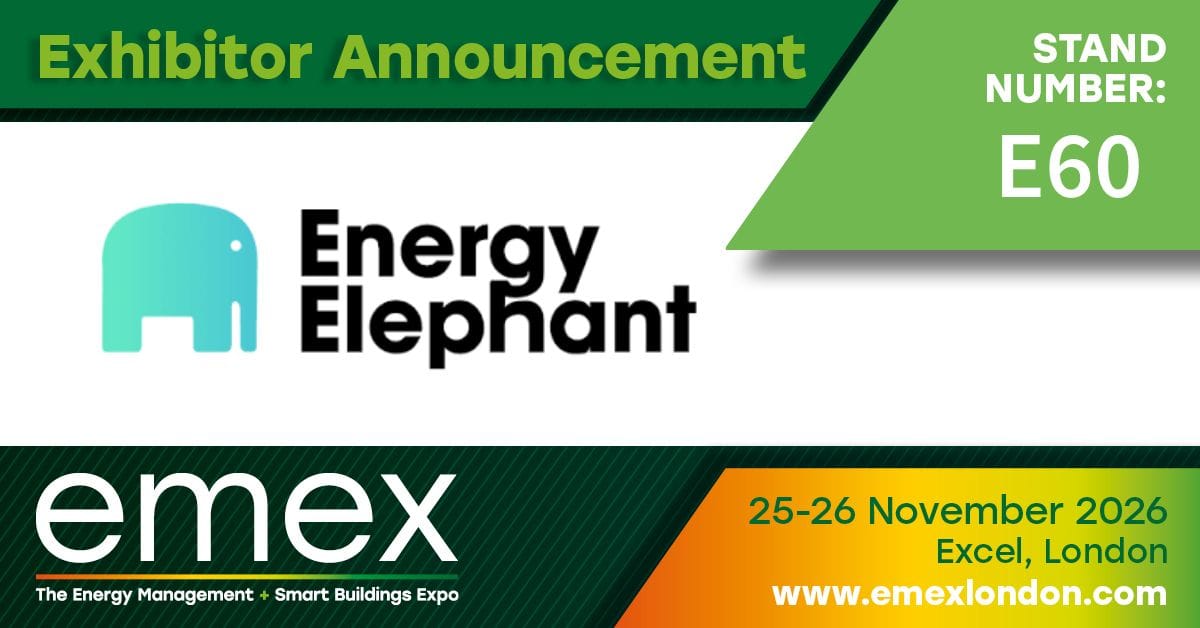
EnergyElephant will be exhibiting at EMEX 2026, the UK's leading Energy Management and Smart Buildings Expo, taking place at ExCeL London on 25–26 November 2026.
Visit the team at Stand E60 to discover how better data can support more confident energy, resilience, and sustainability decisions for your organisation.