Complete Guide to Energy & Sustainability Management Software for Hotels
Discover how energy and sustainability management software turns utility, meter, occupancy, and building data into better operational, financial, and investment decisions for Hotel and Hospitality owners/operators.

Hotel and Hospitality owners/operators rarely suffer from a lack of data.
The problem is that the data they need in order to understand building performance is often scattered across different systems, silos, suppliers, spreadsheets, meters, and teams.
That fragmentation can often make seemingly simple questions surprisingly difficult to answer:
- Why has electricity consumption increased?
- Is higher gas use due to colder weather, increased occupancy, an operational issue, or a leak?
- Which hotel in the portfolio is performing least efficiently this month?
- Is overnight baseload increasing, or is it simply high compared with a typical building?
- Are utility bills accurate, and have tariffs or pricing changed?
- Did the new HVAC upgrade deliver the savings that were promised?
- Are carbon, energy, and water targets on track, or are they likely to be missed by year end?
- Can reliable data be produced quickly when owners, investors, corporate customers, auditors, or sustainability teams request it?
The challenge, then, is not creating or collecting more data.
It's bringing the right data together in a timely manner, so that owners and operators can see exactly what's happening across a property – or an entire portfolio – and make better-informed decisions about cost, efficiency, investment, and sustainability.
That is what the best energy and sustainability management software is designed to do.
This short guide explains what hotel sustainability software is, what it can reveal, and where it fits alongside a Property Management System (PMS), Building Management System (BMS), smart meters, guest room controls, finance software, and Business Intelligence (BI) tools.
What is hotel sustainability and energy management software?
Sustainability software for hotels, or simply 'hotel sustainability software', is a digital platform used to create, collect, organise, analyse, and report environmental and utility performance data across a hotel or hotel portfolio.
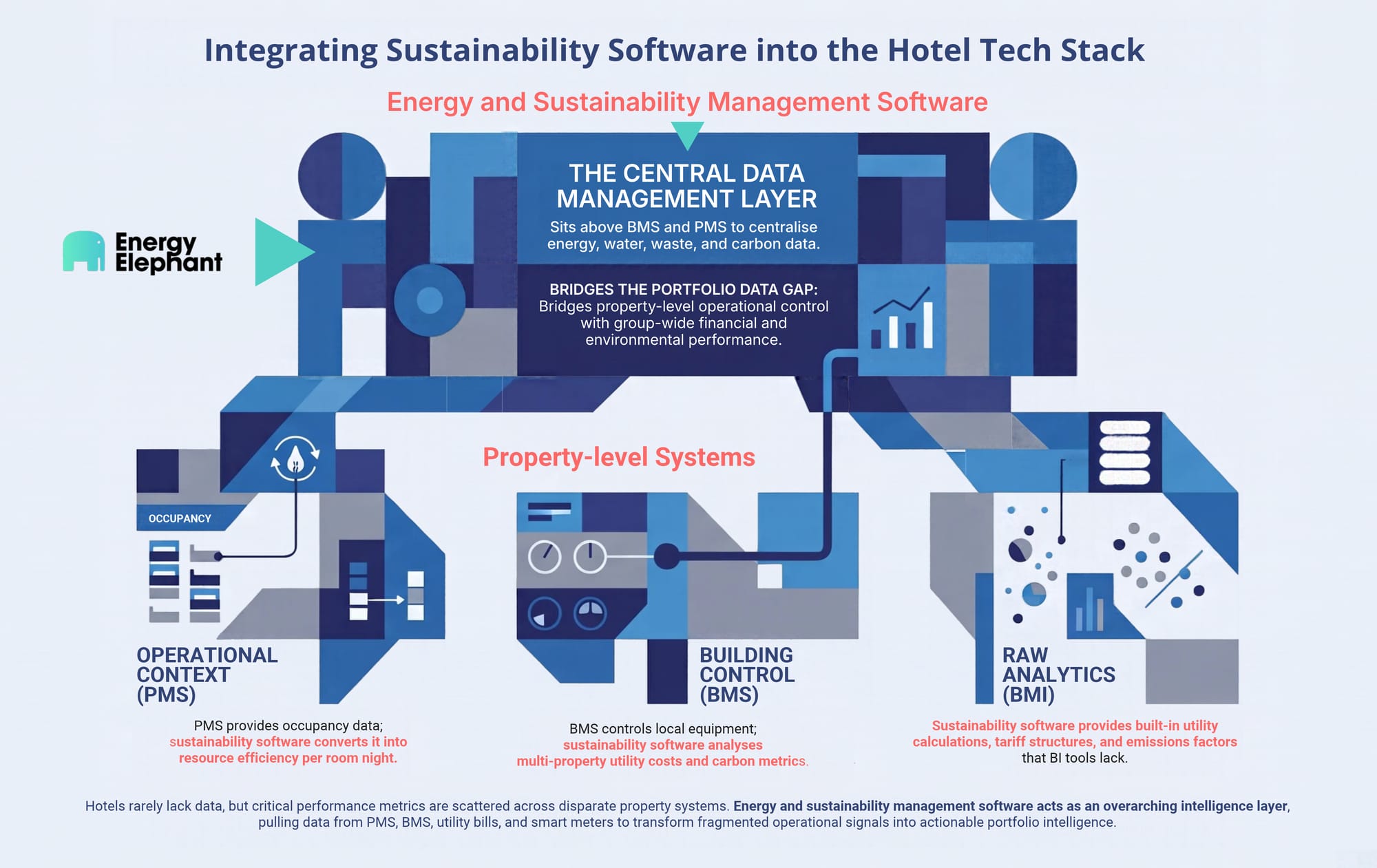
It acts as a central data management, analytics, and reporting layer between the information generated by buildings/assets and the people responsible for making decisions about them.
Depending on the platform, that information might include energy consumption, utility costs, water, waste, carbon emissions, smart meter/submeter data, BMS or IoT sensor data, on-site renewable generation, budgets, targets, operational KPIs, and efficiency projects.
Relevant information may come from utility suppliers, meters, building systems, the PMS, finance systems, renewable energy systems, or sustainability teams. The aim is to move from fragmented datasets towards a more complete, continuously updated view of performance.
EnergyElephant, for example, brings energy, water, waste, utility bill, smart meter, and IoT data together so organisations can set baselines, benchmark properties, and analyse performance across portfolios.
What do EMS, EnMS, BMS, & sustainability software mean in hotels?
Hospitality technology terminology can be confusing, with similar terms often used to describe systems that serve different purposes.
EMS (Energy Management System) is commonly used in hotel and building technology to describe systems that monitor and control energy-consuming equipment – for example, occupancy-based guest room HVAC controls, lighting, or other building services.
EnMS (Energy Management System) is the abbreviation used in standards such as ISO 50001 for the broader organisational framework used to manage and continually improve energy performance through policies, objectives, targets, data, action plans, and defined processes.
A BMS monitors and controls building systems such as heating, ventilation, cooling, plant, and, in some cases, lighting, access control, and fire safety systems.
Energy and sustainability management software generally sits above or alongside these technologies, bringing different datasets together for analysis, benchmarking, reporting, target management, and decision-making.
When evaluating software, one of the first considerations should be whether the system manages data, equipment, reporting, or a combination of all three.
Why sustainability software is becoming an important layer in the hotel tech stack
The PMS remains the operational backbone for reservations, room inventory, guest records, billing, and the guest stay. But it was not designed to become the system of record for kilowatt-hours, cubic metres of water, utility tariffs, emissions factors, interval data, renewable generation, or sustainability project return on investment (ROI).
Likewise, a BMS may provide highly detailed information about the plant and systems within a single property, without giving an owner a consistent portfolio-wide view of energy, cost, water, and carbon performance across 25 hotels. Because a BMS rarely has access to actual utility bill data, it may also lack visibility of true energy costs, tariffs, charges, and penalties.
Energy and sustainability management software fills that gap.
For owners and operators, that final layer becomes increasingly valuable as the number of properties, meters, reporting requirements, and operational systems increases.
What does hotel sustainability software do?
The exact functionality varies between platforms, but most hotel buyers should look for several core capabilities.
1. Energy consumption & cost management
A sustainability platform should provide a clear view of how much energy a hotel consumes, when it consumes it, and what that consumption costs. This may cover electricity, natural gas, heating fuels, district heating, renewable/solar generation, interval/smart meter data, tariffs, and historic consumption.
At portfolio level, owners should be able to move from a group view to individual hotels, meters, fuels, and time periods without manually consolidating multiple spreadsheets.
2. Utility bill management & validation
Utility invoices contain valuable operational and financial information, but extracting it manually across multiple hotels or hospitality locations can be extremely time-consuming.
Software can automate parts of that process by capturing bill data and highlighting issues that need attention. EnergyElephant, for example, can automatically retrieve and process utility bills and flag issues, including unusual charges, estimated readings, tariffs, and capacity-related costs.
For Finance teams, this brings sustainability data much closer to cost control.
3. Energy monitoring & anomaly identification
Monthly bills tell you how much energy you used. Detailed meter data – from smart meters or half-hourly meters – shows when you used it and can reveal patterns in how that energy is being consumed.
That distinction can reveal patterns hidden within a monthly total – such as unnecessary night-time baseload, HVAC operating outside expected hours, unusual peaks or troughs, changing refrigeration loads, equipment starting earlier than necessary, or consumption remaining high during periods of low occupancy or closure.
Detailed smart meter, submeter, and BMS/IoT data can therefore help teams identify where investigation or intervention is warranted.
EnergyElephant’s real-time data capabilities can bring detailed meter and sensor information into the same environment as wider energy and sustainability data.
4. Carbon & sustainability reporting
Energy data is also a key input to carbon reporting.
A sustainability platform can help automate the process of translating electricity, fuels, transport, water, waste, and other relevant activities into environmental reporting.
Depending on the organisation, this could support carbon/GHG inventories, Scope 1, 2, and relevant Scope 3 reporting, owner and investor reporting, corporate sustainability reports, ISO 50001, CDP, environmental certifications, and internal decarbonisation targets.
The important capability is traceability. Teams should be able to understand where reported figures came from, what data and emission factors were used, and whether the underlying information can be retrieved if somebody challenges a number.
5. Water & waste management
Energy is only part of a hotel’s resource footprint. Guestrooms, laundries, kitchens, pools, spas, and grounds can also place significant demand on water, making effective water management just as important.
Waste adds another layer of data – covering volume, weight, category, diversion, disposal, and cost.
A sustainability platform can bring these datasets together in one place, rather than leaving energy, water, waste, and carbon fragmented across separate systems.
6. Portfolio benchmarking & occupancy-normalised performance
For hotel asset owners and multi-property operators, one of the greatest advantages of centralised sustainability data is the ability to compare assets.
But absolute totals only tell part of the story.
A 400-room resort should not automatically be compared with an 80-room boutique hotel based on total consumption alone. Hotel energy and water demand are influenced by occupancy and operational activity.
Combining PMS or other operational data with utility information allows hotels to create more meaningful performance KPIs, such as:
- Energy consumption per occupied room night
- Carbon emissions per occupied room night
- Water consumption per occupied room night
- Utility cost per occupied room night
- Energy consumption per square metre
This is not simply a software convention. The hotel industry's Hotel Carbon Measurement Initiative (HCMI) calculates carbon footprint per occupied room and per area of meeting space, while the Hotel Water Measurement Initiative (HWMI) similarly uses water per occupied room and meeting space activity.
Hotel performance data becomes more useful when consumption is placed in an operational context.
7. Projects, savings, & ROI tracking
Hotel sustainability programmes eventually lead to CapEx investment decisions.
Should the group install solar PV? Upgrade HVAC? Introduce heat pumps? Improve guest room energy controls? Add submeters? Replace refrigeration or lighting? Install pool covers? Optimise the BMS?
A good platform should help establish what performance looked like before an intervention and compare it with what happened afterwards.
EnergyElephant supports historical baselines, project tracking, on-site renewable accounting, and ROI/payback analysis for energy efficiency initiatives.
For asset owners, that shifts sustainability management from a reporting exercise towards improved capital allocation and investment performance.
Core hotel sustainability software features
Not every hotel needs every capability. Rather than comparing vendors against the longest possible feature list, it's more useful to group requirements around the outcomes you actually need to achieve.
A practical shortlist should cover:
- Data collection: Utility bills, meters, submeters, BMS/IoT, APIs, and historic imports
- Energy and cost: Consumption, tariffs, bill validation, budgets, peaks, baseload, and interval analytics
- Sustainability: Carbon calculations, water, waste, renewable energy, targets, and reporting
- Portfolio management: Multi-property hierarchies, benchmarking, custom KPIs, and permissions
- Operational context: Occupancy or activity normalisation and integrations with hotel systems
- Projects: Baselines, savings verification, ROI, and payback
- Governance: Audit trails, emissions factors, user controls, and data provenance
- Outputs: Dashboards, reports, exports, APIs, and enterprise BI integration
A 40-bedroom independent hotel and a 20-property luxury hotel group are solving very different data problems.
When comparing platforms, focus less on the number of features and more on whether the software can answer the questions that matter to your organisation. Ask yourself: What problem am I trying to solve?
Integrations with other hotel systems
Energy and sustainability management software becomes substantially more useful when it can receive or simply add data from other systems.
Potential connections include:
- PMS: Occupancy, occupied rooms, guest nights, or other activity data can provide context for resource consumption
- BMS: BMS data can relate utility consumption to HVAC, plant, operating schedules, temperatures, and equipment behaviour
- Smart meters and submeters: Detailed consumption data can reveal peaks, baseload, and patterns invisible in monthly bills
- IoT sensors: Temperature, humidity, equipment, flow, occupancy, and other data can provide further operational context
- Utility suppliers: Automated bills and consumption feeds can reduce manual administration
- Finance and accounts payable: Cost data can connect resource efficiency with budgets and financial performance
- Renewable energy systems: Solar PV and other generation data can show self-generation, imports, exports, and associated savings
- BI platforms: Sustainability data may need to flow into broader enterprise reporting or data warehouse environments
When evaluating synergies/integrations, look beyond whether a connection is available and consider what data moves between systems, how often it is exchanged, in which direction it flows, and what happens if the connection fails. Try to keep it simple.
Cloud-based vs on-premise sustainability software
Most modern energy and sustainability management platforms are cloud based. That is particularly useful for multi-property hospitality organisations because owners, individual hotels, Finance, Sustainability, and regional teams may all need access from different locations.
Cloud deployment can make portfolio centralisation, software updates, scalability, and remote access easier, but it does not remove the need to review cybersecurity, access controls, backups, availability, data ownership, and portability. Available support is also critical.
For most buyers, the key consideration is not whether a platform is cloud-based or on-premise, but whether its architecture integrates securely with the systems and data already in place.
Benefits of hotel sustainability software
Different stakeholders should get different value from the same platform.
Engineering & Facilities
What they need from the data: Fast access, easy exports, identify anomalies, baseload, peaks, operating pattern changes, and the impact of BMS adjustments or efficiency projects
Sustainability
What they need from the data: Centralise environmental/carbon data, automate calculations, track targets, improve consistency, and create reliable audit trails
Finance & Procurement
What they need from the data: Understand utility spend, tariffs, invoice accuracy, budgets, forecasts, and project returns
Owners & Senior Management
What they need from the data: Compare assets, identify underperformance, prioritise CapEx, monitor portfolio targets, and understand investment ROI
While guests – arguably the most important stakeholder – may never see the software, the aim is to reduce unnecessary energy consumption while maintaining the comfort and experience they expect and deserve.
Hotel sustainability software vs other hotel systems
A hotel does not need another piece of technology simply because another category exists. Understanding what each system is designed to do helps prevent unnecessary duplication. But when energy or sustainability performance matters, specialist software is the stronger choice – offering greater depth, more relevant functionality, and better analysis than a generalist platform stretched across too many use cases and stakeholders.
1. Sustainability software vs PMS
The PMS manages the guest stay – including reservations, occupancy, room inventory, guest records, rates, folios, and billing.
Sustainability software manages environmental and utility performance.
The systems overlap when PMS information – particularly occupancy or activity data – is useful for explaining resource consumption.
- PMS = operational context
- Sustainability software = resource performance intelligence
Neither replaces the other and they should "play nice" with each other to create synergies.
2. Sustainability software vs BMS
A BMS is primarily concerned with building operation and control. It may monitor or control boilers, chillers, air-handling units, HVAC zones, temperatures, schedules, pumps, and other plant. It is also far more likely to need strong cybersecurity to prevent significant risks.
Sustainability software can use BMS information alongside utility and other datasets to understand how that operation affects energy, cost, and carbon performance.
A simple distinction is:
- The BMS helps operate the building
- Sustainability software helps assess how the building is performing – and where that performance can be improved
3. Sustainability software vs hotel energy management or guest room control systems
Guest room energy management technology can automate equipment based on room occupancy – for example, adjusting HVAC when rooms are vacant. That is direct operational control.
Sustainability software performs a different role – analysing broader performance across rooms, meters, buildings, utilities, time periods, and portfolios.
A hotel may therefore benefit from both:
- The control system can reduce consumption
- The sustainability platform can help determine whether consumption actually fell – and by how much
4. Sustainability software vs BI tools
BI tools can analyse almost any dataset provided to them. But they generally rely on someone first creating reliable, structured data.
Specialist sustainability platforms typically provide domain-specific functionality such as utility data processing, meter hierarchies, emissions factors, carbon calculations, unit rate analysis, sustainability KPIs, baselines, target tracking, and energy specific reporting.
BI and sustainability software may therefore complement one another.
Do hotels need all of these systems?
No. Technology requirements should reflect operational complexity.
A smaller independent property may gain considerable value from bills, existing smart meter data, and a relatively simple sustainability platform. A complex resort or multi-property group may need multiple specialist systems working together.
The right tech stack depends on the questions the organisation needs to answer – not on owning every available category of hotel technology.
How to choose hotel sustainability software
1. Start with hotel type & operational complexity
Before comparing vendors, document what you actually operate. Consider property count, rooms, locations, currencies, utility suppliers, hotel type, restaurants, conference spaces, laundry, spas, pools, grounds, renewables, EV charging, existing BMS infrastructure, meters, reporting obligations, and sustainability targets.
A straightforward city hotel has different requirements from a destination resort with multiple buildings, pools, conference facilities, kitchens, laundries, extensive grounds, and complex energy systems.
2. Evaluate workflows before feature lists
When evaluating a platform, start with the business problems you need to solve rather than the presence of features such as AI.
Ask vendors to demonstrate real-world scenarios such as:
- Which hotel in our portfolio has deteriorated most over the last quarter?
- Show us how we would identify a rising overnight baseload
- Show us how electricity consumption compares with occupancy
- How would our Finance team identify unusual utility charges?
- We installed a heat pump last year – show us whether it delivered the expected savings
- Show us the data and methodology behind this carbon figure
Features become meaningful when attached to actual decisions.
3. Check integration depth & ecosystem fit
Map your existing systems first. Then identify which information the sustainability platform genuinely needs.
Where integration matters, understand the APIs, file imports, smart meter feeds, supplier connections, BMS protocols, refresh frequency, historic data migration, ownership, and export arrangements.
For hotel groups, test integrations at portfolio scale – not only at the flagship pilot property.
4. Review implementation, training, & support
Implementation is primarily a data problem.
Meters need to be identified. Properties need to be mapped. Bills need to be collected. Historic datasets may require cleaning. Users need appropriate permissions. KPIs and baselines need agreement. Integrations need testing.
Before signing, ask exactly what the supplier handles and what your own team will need to provide. Also ask how long onboarding typically takes, what can delay it, and who is responsible for each stage. A supplier with a clear, efficient onboarding process is usually better equipped to get you to value quickly.
Hotel sustainability software pricing
Pricing models vary considerably because sustainability platforms deal with very different organisations and data volumes.
1. Common pricing factors
Pricing may depend on:
- Number of properties, buildings, or assets
- Number of meters or data points
- Number of users
- Volume and frequency of data collected
- Modules included – such as energy, water, waste, vehicles, or real-time data
- BMS, IoT, utility, or API integrations
- Reporting requirements
- Historic data migration
- Implementation complexity
- Support level
- AI usage or credits
- Contract length
Some vendors publish pricing. Others quote on a portfolio basis.
EnergyElephant, for example, publishes tiered per-meter pricing for its Small, Medium, and Large plans, with enterprise pricing available separately. This is to help buyers know in advance the approximate budgets necessary.
Whatever the pricing model, compare total cost of ownership, not just the subscription price.
A cheaper platform requiring substantial manual data preparation may ultimately cost more to operate than one that automates it.
2. Questions to ask vendors about pricing
At a minimum, ask:
- What is included in the core licence?
- Is pricing based on properties, meters, users, data points, or modules?
- Are implementation and onboarding included?
- Do interval data, utility integrations, BMS/IoT integrations, or API access cost extra?
- What does historic data migration cost?
- What level of support and training is included?
- How does pricing change as the portfolio grows?
- What happens at renewal?
- Are there minimum contract periods?
- Can we export all our data if we leave?
Before investing significant time in demos and vendor evaluation, it's also useful to establish an indicative internal budget.
EnergyElephant's procurement guidance recommends securing in-principle budget alignment before beginning a detailed RFP/tender or supplier evaluation process.
Best sustainability software for different hotel types
There is no single “best” sustainability platform for every hotel. The right system depends on the complexity of the property, portfolio, existing technology, reporting requirements, and what management wants to improve.
1. Boutique & independent
Key consideration: Simple setup, automated bill processing, clear energy and cost reporting, water and carbon tracking, existing meter support, low administration, and easy export.
2. Multi-property groups
Key consideration: Portfolio dashboards, standardised KPIs, benchmarking, role-based permissions, multiple suppliers/currencies, scalable meter hierarchies, consistent emissions methodology, and project tracking.
3. Resorts & full-service hotels
Key consideration: Detailed metering, BMS/IoT integration, interval data, water monitoring, baseload analysis, occupancy normalisation, renewable energy accounting, departmental comparisons, and major project tracking.
The best system is not necessarily the one with the most functionality; it's the one that matches the operational complexity of the organisation and makes the information easier to use.
FAQ
1. What is the difference between energy management software & sustainability software?
The terms overlap.
Energy management software typically focuses more closely on energy consumption, meters, cost, efficiency, baselines, and operational performance.
Sustainability software may extend into carbon (Scope 1, 2 and 3), water, waste, ESG data, reporting, targets, and environmental metrics.
Many modern platforms combine both.
2. Is cloud sustainability software better for hotels?
Cloud software is particularly well suited to distributed hotel portfolios because teams can access a common platform from different locations.
The important considerations remain available support, cybersecurity, access controls, data ownership, integrations, backups, and export capability.
3. How much does hotel sustainability software cost?
There is no standard industry price. Cost may depend on property count, meters, integrations, data frequency, modules, implementation, reporting requirements, and support.
Compare total cost of ownership rather than a headline subscription price.
4. What integrations should hotel sustainability software have?
That depends on your objectives.
Potential connections include PMS, BMS, smart meters, submeters, IoT sensors, utility suppliers, finance systems, renewable energy systems, and BI platforms.
Don't integrate systems simply because you can. Integrate the data required to answer meaningful business questions.
5. What is the most widely used hotel energy/sustainability management platform?
Unlike PMS technology, there is no single energy or sustainability management platform that can realistically be described as the universal hotel standard.
The market spans energy management systems, carbon accounting platforms, ESG reporting tools, utility management systems, BMS analytics, and broader sustainability management software.
Choose according to your use case rather than market share alone.
6. How long does sustainability software implementation take?
It depends primarily on data complexity.
A single hotel using bills and a small number of meters may be relatively straightforward, while a multinational portfolio requiring historic data migration, BMS connections, supplier integrations, and common KPI structures will take more work.
Ask vendors to distinguish clearly between technical setup, data onboarding, integrations, validation, training, and portfolio rollout – and to provide realistic timelines for each stage.
7. What is the difference between a BMS & sustainability management platform?
A BMS helps monitor and control building equipment. A sustainability management platform analyses resource, cost, carbon, and performance data across buildings and portfolios.
The BMS can therefore be an important data source for the sustainability platform.
8. Does sustainability software replace a hotel's PMS?
No. The PMS is primarily concerned with the guest, room inventory, reservations, operations, and billing. Sustainability software is concerned with resource and environmental performance.
PMS occupancy information can, however, provide extremely useful context for energy, water, and carbon analysis.
9. Can a small hotel use sustainability software?
Yes. A small hotel does not necessarily require advanced sensors, a new BMS, or a complex integration project.
Existing utility bills and meter data may be enough to establish baselines, understand consumption, manage carbon, and identify opportunities.
10. What should I look for in an energy/sustainability software demo?
Don’t spend the entire demo watching the vendor navigate dashboards. Give them real scenarios and ask them to show exactly how the platform handles them.
Have them demonstrate how a bill enters the system, how anomalies are identified, how hotels are benchmarked, how occupancy is incorporated, how baseload is investigated, how carbon is calculated, how project savings are verified, and how your data can be exported.
Then, where possible, test the platform using some of your own hotel data.
11. How do I know when it's time to switch sustainability software?
Warning signs include growing dependence on spreadsheets, heavy manual data entry, poor customer support, disconnected datasets, weak integrations, unreliable portfolio reporting, limited interval data capability, poor audit trails, difficulty comparing properties, and an inability to demonstrate project ROI.
A useful test is whether the software makes energy and sustainability data easier to use rather than simply giving teams another system to maintain.
Where hotel sustainability software fits – from reporting system to operational intelligence
Hotels already generate enormous amounts of information. The challenge is rarely a lack of data – it's fragmentation.
Energy and sustainability management software can create a common layer through which environmental performance is understood alongside operational and financial performance.
And that changes the conversation.
Energy and water become operational signals. Cost provides financial context. Carbon becomes a measurable consequence of operating decisions.
When those signals are brought together across an entire portfolio, sustainability data becomes a source of business intelligence – helping hotels understand performance, identify opportunities, and make better decisions.
How EnergyElephant helps hotel owners & operators
EnergyElephant helps organisations bring fragmented energy, waste, water, utility bill, smart meter, IoT, cost, and carbon data together in one place.
Hotel owners and hospitality operators can use it to:
- Centralise data: Bring utility bills, meter data, water, waste, carbon, and other sustainability information together
- Understand performance: Benchmark properties, track performance metrics, analyse interval data, identify baseload, and investigate unusual consumption
- Control costs: Validate utility bills, track expenditure, and identify cost-saving opportunities or cost over-runs
- Track sustainability: Establish baselines and targets, calculate carbon, and monitor energy, water, waste, and renewable generation
- Measure investment performance: Analyse project savings, ROI, and payback
- Create portfolio visibility: Give owners, Finance, Operations, Engineering, and Sustainability teams a common view of performance
The objective is to turn hotel energy and sustainability data into better operational, financial, and investment decisions.
Want to see what your existing hotel data can tell you?
Start our free 30-day trial using your own bills and data – no hardware or credit card required to get started:
Or, if you're currently evaluating energy and sustainability management software for a hotel portfolio, download our free procurement resources:
Download the Sustainability Software Business Case Template
Download the EnergyElephant RFP / Tender Guide