Energy Resilience by Design: Why Data Quality Matters More Than Ever
Energy volatility is reshaping business risk. Discover how high-quality data enables resilience, flexibility, and smarter energy strategy.


For too long, company boards and senior executives have underestimated energy as a financial risk. Today, volatility and energy security are the hidden threats to budgets, operations, and strategic objectives.
Energy resilience – the ability to anticipate, absorb, and respond to disruptions in energy supply, price, or availability – is therefore emerging as a core organisational capability. However, resilience does not come from infrastructure alone. It depends on high-quality, actionable data to help make better informed decisions.
Without accurate, accessible, and timely data, organisations cannot understand their exposure to energy risks, identify opportunities for flexibility, or evaluate the financial impact of resilience or decarbonisation investments.
In this article, we discuss:
- How energy volatility is reshaping operational and financial risk
- Why organisations must transition from passive energy efficiency to active energy management / strategy development
- Why the success or failure of resilience strategies ultimately depends on the quality of the underlying data and prediction modelling
Investing in high-quality data and analytics gives organisations the ability to anticipate disruption, optimise energy assets, and convert volatility into competitive advantage. Those that do not will increasingly struggle to manage rising energy risk.
Energy is No Longer Just an Operational Cost
For decades, energy management was largely a technical discipline. Facilities teams focused on reducing consumption, improving equipment efficiency, and negotiating supply contracts. For most organisations, energy was simply just another operational cost.
In today's energy markets, volatility can create sudden and significant financial exposure. Price spikes, grid constraints, and supply disruptions now pose real risks to budgets and operational continuity.
Many organisations are responding by deploying storage, flexible demand, alternative supplies, and onsite generation. Yet these strategies depend on one often-overlooked foundation: data quality.
Without timely, reliable, granular data, organisations cannot:
- Accurately assess and manage energy risk
- Operate flexibility assets quickly and effectively
- Measure the financial value and risk mitigation of resilience investments
In a modern energy system, resilience is not just an infrastructure challenge – it is an information challenge.
1. The New Energy Risk Landscape
Energy prices can fluctuate dramatically due to:
- Geopolitical instability affecting both the source and transport of energy supplies
- Rapid renewable expansion and high demand infrastructure, e.g. data centres
- Grid constraints both at the transmission and distribution level
- Extreme weather and natural disaster events
- Shifting regulatory frameworks
Energy can no longer be treated as a static overhead. It behaves like a financial risk variable, capable of affecting budgets, operations, people, and long-term competitiveness.
Organisations managing energy through spreadsheets and siloed systems are effectively navigating this volatility blind, or with at least one hand tied behind their back.
Forward-thinking organisations now treat energy as a risk and opportunity to actively manage, driving the emergence of energy resilience as a strategic operational discipline.
2. The Financial Exposure Hidden in Energy Systems
Traditional energy projects are evaluated on energy savings payback. Resilience investments create value differently. Their primary impact is avoiding downside risk:
- Operational disruptions
- Peak demand charges or curtailments
- Price volatility exposure
- Emergency energy procurement
Additionally, resilience assets can generate revenue through:
- Demand-side response (DSR) or demand-side management (DSM) programmes
- Ancillary service markets
- Flexibility markets
When both risk reduction and revenue potential are considered, the financial case for resilience can be compelling.
3. Energy Risk, Resilience, & Security
To navigate today’s energy landscape, organisations must distinguish between three concepts:
Energy Risk
Financial or operational exposure caused by fluctuations in supply, price, or availability. Risks arise from market volatility, supply constraints, infrastructure failures, geopolitical / transport disruption, trade disputes, and regulatory change.
Energy Resilience & Adaptability
An organisation’s ability to anticipate, absorb, and recover from energy disruptions while maintaining operational continuity. Built through:
- Visibility into energy systems
- Flexible infrastructure and scenario playbooks
- Predictive (and preventative) analytics
- Automated response mechanisms
At its core, resilience is data-driven.
Energy Security
Energy security operates at the local, national, or regional level. Governments and energy providers are responsible for ensuring reliable energy supply through infrastructure investment, system balancing, and market design. Businesses contribute indirectly through efficient consumption, demand flexibility, fuel switching, energy storage, and distributed energy resources.
4. From Energy Efficiency to Energy Management
Traditional energy management focuses on static efficiency projects, e.g. lighting upgrades, insulation, and equipment replacements.
The modern energy system is dynamic. Renewables fluctuate, grid conditions change, and market prices spike. Organisations now require orchestrated energy management – the continuous co-ordination of assets, data, and operational / strategy decisions.
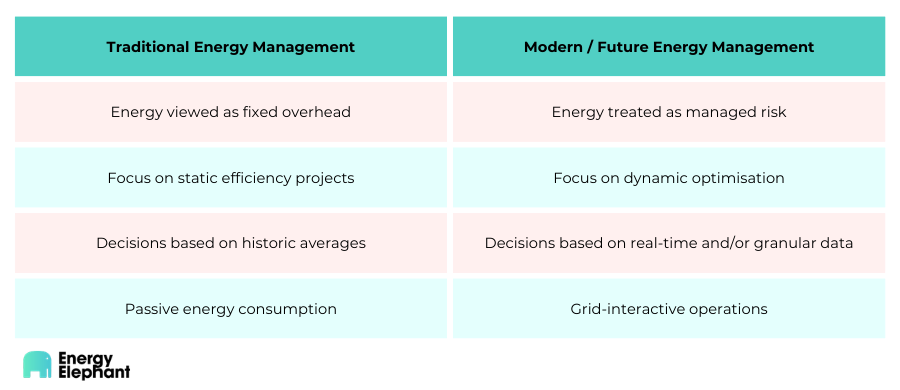
Modern/future energy management co-ordinates flexible loads, onsite generation, storage assets, smart electric vehicle (EV) charging, and market/grid signals. But effective management is impossible without high-quality energy data.
5. Why Data Quality Determines Energy Resilience
Energy resilience is often framed as an infrastructure challenge, but it is first and foremost a data challenge.
Without high-quality data, organisations cannot:
- Identify when and where energy risk actually exists
- Understand peak energy demand behaviour and impacts
- Determine which loads can safely flex or move to a different time period
- Evaluate the financial value and sustainability improvements of resilience investments
High-quality data enables three critical capabilities – visibility, automated response, and measurable key performance indicators (KPIs).
1. See Risk Before it Hits
Granular energy data reveals when and where risk occurs – peak energy demand patterns, operational stress points, abnormal consumption, and exposure to grid constraints.
2. Act Instantly
Once patterns are understood, systems can be designed to respond automatically – shifting demand during price spikes or high carbon intensity periods, co-ordinating storage and generation, and responding to grid events in real time.
3. Measure What Matters
Reliable data allows organisations to quantify resilience outcomes – peak energy demand avoided, volatility reduced, grid response effectiveness, and carbon reductions from load shifting or stored energy use.
6. Energy Data Quality: The Good, the Bad, & the Ugly
Despite the importance of energy data, many organisations struggle with significant data quality challenges. The quality of data typically falls into three categories:
1. The Good – High-quality Energy Data
In well-managed systems:
- Data is captured automatically
- Data coverage is comprehensive
- Sources are auditable and verifiable
- Stakeholders can access the information they need
This enables reliable reporting, operational optimisation, and strategic decision-making.
2. The Bad – Common Data Failures
Many organisations experience persistent issues such as:
- Data gaps
- Estimated data/meter readings
- Duplicated billing records or billing re-issuing
- Siloed building management systems (BMS)
- Restricted access to operational data
These issues undermine confidence in energy analysis and limit the ability to act on insights.
3. The Ugly – Counter-intuitive Data Scenarios
Some data challenges are less obvious:
- Proxy metrics such as building energy ratings (BER) being used as substitutes for actual energy consumption
- Smart meters repeating incorrect readings
- Closed or vacant facilities generating unexplained energy bills
These scenarios require careful investigation and analytical expertise to resolve.
7. The Energy Data Maturity Curve
Most organisations do not move directly from traditional energy management to modern energy resilience. Instead, they progress through a series of data maturity stages, each unlocking new capabilities.
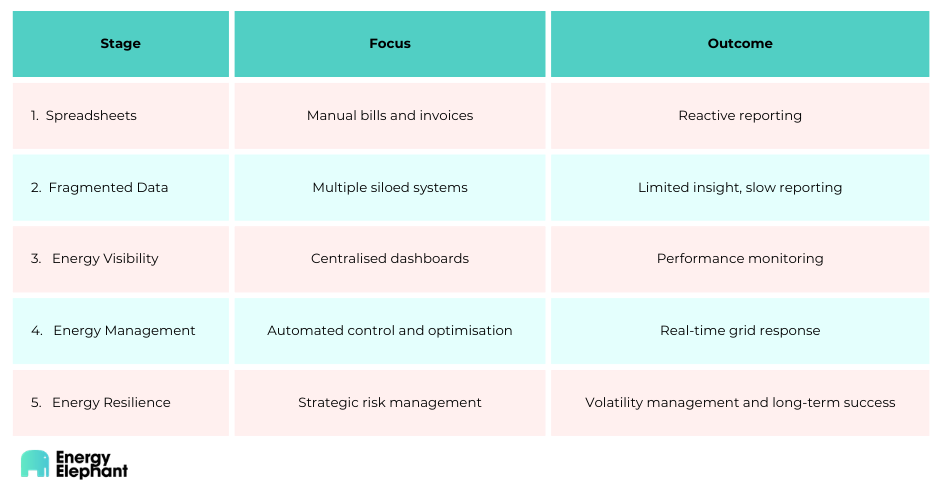
Stage 1: Spreadsheet Energy Management
In the earliest stage, utility bills and invoices are collected from suppliers and manually entered into spreadsheets for basic tracking and reporting. Data is often incomplete or inconsistent (and prone to human error), and the primary objective is simply understanding overall consumption and cost.
Energy management is largely reactive, focused on historical reporting rather than operational insight. This is where most organisations begin.
Stage 2: Fragmented Data Systems
As organisations grow, energy data begins to accumulate across multiple systems – utility billing platforms, BMS, smart meters, procurement databases, and sustainability reporting tools.
However, these systems rarely communicate with one another. As a result, data becomes fragmented and difficult to reconcile, making reliable analysis challenging.
Stage 3: Energy Visibility
The next stage involves centralising energy data into a single platform, enabling organisations to establish a reliable baseline for energy performance. The platform provides accurate consumption tracking, reliable cost analysis, benchmarking across sites, and improved reporting for sustainability and compliance.
Energy management moves from reactive reporting toward operational insight. However, decision-making is still largely manual.
Stage 4: Energy Management
With reliable and granular data in place, organisations can begin actively co-ordinating their energy assets, including automated demand response, optimised use of battery storage, co-ordination of onsite generation, smart EV charging, and load shifting during price, carbon, or grid curtailment events.
Energy systems become grid-interactive, responding dynamically to external conditions.
Stage 5: Energy Resilience
At the highest level of maturity, organisations treat energy as a strategic risk variable.
They use advanced analytics and high-quality data to model exposure to market volatility, forecast demand and energy costs, co-ordinate flexible assets across sites, participate in flexibility markets, and stabilise / reduce long-term energy budgets.
Energy management evolves from operational efficiency into strategic resilience management.
8. Turning Energy Data into Operational Intelligence
Modern energy systems generate vast amounts of data. However, raw data alone provides little value. Analytics platforms turn raw data into actionable insights by:
- Detecting anomalies and inefficiencies
- Forecasting demand patterns
- Identifying flexibility opportunities
- Modelling exposure to price volatility
This allows a shift from reactive reporting to proactive management.
9. The Demand-side Flexibility Toolkit
Organisations can deploy a range of tools to enhance resilience, but all depend on data visibility:
1. Battery Energy Storage System (BESS)
Batteries provide fast, controllable response to grid events and market signals. They enable peak shaving, backup capability, and participation in flexibility markets.
2. Flexible Load Control
Demand flexibility is often the most cost-effective resilience strategy. Systems such as HVAC, refrigeration, pumping, and batch processes can shift demand when co-ordinated intelligently.
3. Thermal Storage
Thermal storage allows organisations to shift heating or cooling demand across time, reducing peak electricity demand.
4. Onsite Generation
Solar PV, combined heat and power (CHP), biomass power systems, and wind generation reduce dependence on external supply and improve energy autonomy.
5. Smart EV Charging & Vehicle-to-Grid (V2G)
As vehicle fleets electrify, they introduce significant flexible load and potential storage capacity.
10. A Practical Roadmap for Implementation
Organisations seeking to improve energy resilience should focus on five priorities:
- Collect and validate data – establish visibility into energy consumption and costs
- Build a reliable baseline – centralise and review / audit energy data
- Invest in a fit-for-purpose analytics platform – turn data into actionable insights
- Identify and deploy flexibility assets – BESS, flexible load control, thermal storage, onsite generation, smart EV charging
- Measure resilience outcomes – track operational KPIs and return on investment (ROI)
This approach ensures resilience investments are data-driven, measurable, and impactful.
Data as the Foundation of Energy Resilience
Energy volatility is likely to remain a defining feature of the global energy system for the foreseeable future. In this environment, resilience is no longer optional. However, resilience does not emerge from infrastructure alone. Data quality is the foundation.
Organisations that invest in high-quality energy data gain the visibility required to anticipate disruption, the intelligence to respond dynamically, and the insight to convert volatility into opportunity. Those that continue to rely on fragmented data and spreadsheets will find it increasingly difficult to manage rising energy risk.
In the global shift toward electrified, low-carbon systems powered by renewables, clean technologies, and digital energy networks, the quality of your data determines the strength of your resilience – and resilience is becoming a decisive competitive advantage.