The Domino Effect of Local Ecological Collapse
We are not separate from nature, but downstream from it – and when local ecosystems fail, the consequences travel further and faster than most people realise.


Ecological collapse is not a distant environmental issue confined to scientific reports or disappearing wildlife. When local ecosystems begin to break down, the effects move rapidly into everyday human life – disrupting food production, reducing access to clean water, and placing enormous pressure on already fragile communities.
As droughts intensify, soils degrade, fisheries decline, and harvests fail, environmental stress quickly becomes economic and political instability. Rising food prices, resource shortages, and displacement place strain on borders, governments, and societies. What begins as a local ecological failure can evolve into migration crises, conflict, and humanitarian emergencies far beyond the original source.
In an interconnected world, no ecosystem collapses in isolation. The stability of economies, supply chains, and communities is deeply tied to the health of the natural systems beneath them. We are not separate from nature, but downstream from it – and when local ecosystems fail, the consequences travel further and faster than most people realise.
Raising the nature agenda
In a 2018 Frontiers peer-reviewed article, titled Our House Is Burning: Discrepancy in Climate Change vs. Biodiversity Coverage in the Media as Compared to Scientific Literature, the authors revealed that, from 2000 to 2017, media coverage of climate change was up to eight times higher compared to biodiversity. And that this discrepancy could not be explained by different scientific output between the two issues.
They emphasised that the way in which information is framed and expertise is communicated is crucial for prioritising environmental issues. And they urged for an international communication strategy to raise the nature agenda, including several initiatives that scientists could undertake to better communicate major discoveries to the public and policy makers.
Miles Richardson, Professor of Human Factors and Nature Connectedness, and founder/lead of the Nature Connectedness Research Group, at the University of Derby in the UK, rose to the challenge.
Birth of the Biodiversity Stripes
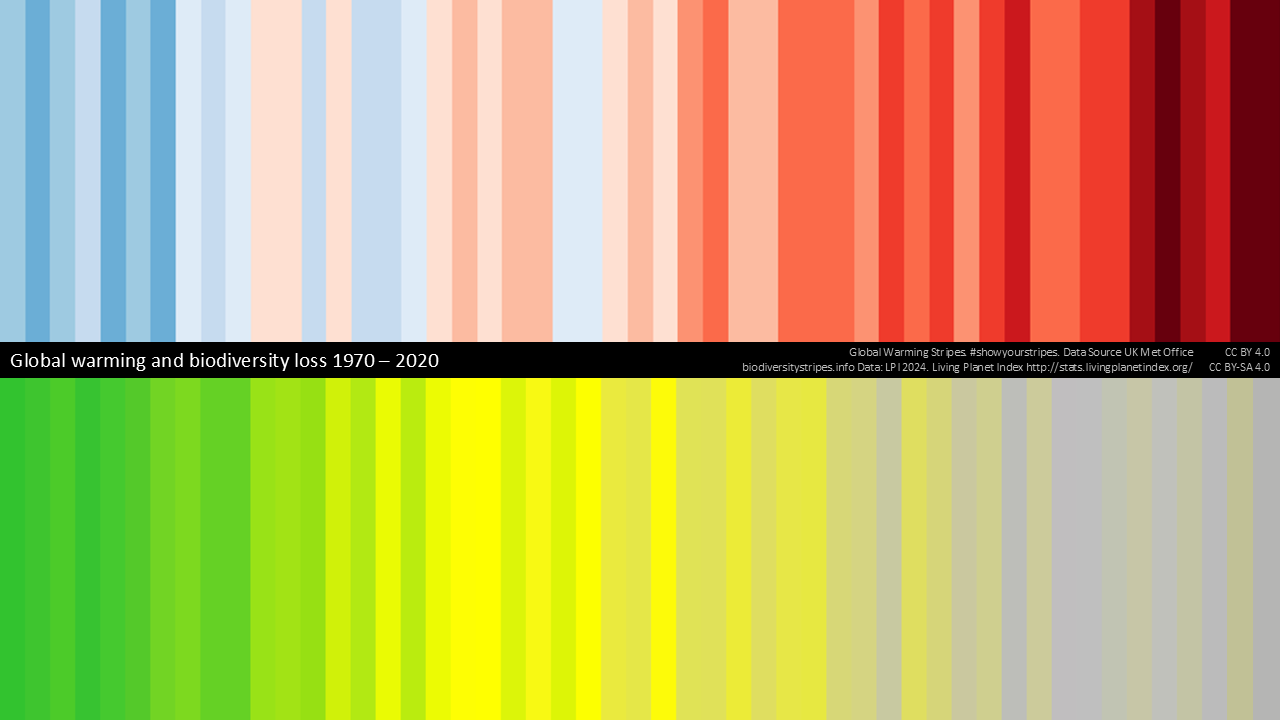
Familiar with the now globally recognised Climate Stripes developed by UK climate scientist Prof. Ed Hawkins at the University of Reading, Prof. Richardson decided to create a version for biodiversity. He found the data, spoke with ecologists, consulted with other experts, and in 2022, he released the Biodiversity Stripes.
In a similar manner to the ‘warming stripes’ graphics, bars of colours are used to illustrate the loss of biodiversity over time.
"There's a battle for attention every day, especially if you live in an urban environment. But the stripes format seems to break through and grab people's attention… I think both the climate and the biodiversity stripes show the symptoms of a failing relationship with nature. That's the underlying cause, and we need to change that." – Prof. Miles Richardson
Whole-of-government, whole-of-society approach
Biodiversity is the foundation of all life on Earth, and fundamental to human well-being. Biodiversity and healthy ecosystems can serve as natural buffers against extreme climate and weather events, such as changing patterns of rainfalls, droughts, storms, and other disasters. They are an important resource for increasing resilience, and reducing the risks and damages associated with negative impacts of climate change.
Ecosystems such as forests, rangelands, peatlands, and wetlands represent globally significant carbon stores. Their conservation, restoration, and sustainability are critical to achieving the targets of the Paris Agreement. By working with nature, greenhouse gas (GHG) emissions can be reduced by up to 11.7 gigatonnes of carbon dioxide equivalent per year by 2030, which is over 40% of what is needed to limit global warming.
But ecosystem degradation is already affecting the well-being of 40% of the global population. And global warming is likely to become one of the most significant drivers of biodiversity loss by the end of the century.
Kunming-Montreal Global Biodiversity Framework
The Kunming-Montreal Global Biodiversity Framework (KMGBF) sets out an ambitious blueprint for the transformation of our societies’ relationship with nature. Its primary goal is to halt and reverse biodiversity loss by 2030.
All Parties are expected to prepare National Biodiversity Strategies and Action Plans (NBSAPS) reflecting the ambition of the KMGBF. To maximise synergy, the NBSAPs should be integrated into broader National Sustainable Development Strategies guided by the 17 Sustainable Development Goals (SDGs) and the Pact for the Future.
The four overarching KMGBF goals to be achieved by 2050 focus on ecosystem and species health:
- To halt human-induced species extinction
- The sustainable use of biodiversity
- Equitable sharing of benefits
- Implementation and finance to include closing the biodiversity finance gap of $700 billion per year
Some of the KMGBF's 23 targets to be achieved by 2030 include:
- 30% restoration of degraded ecosystems
- 30% conservation of land, sea, and inland waters
- Halving the introduction of invasive species
- $500 billion/year reduction in harmful subsidies
The path to 2030 runs through local action
The implementation of the Global Biodiversity Framework happens on the ground, through the actions of people everywhere. And the theme for this year's International Day for Biological Diversity (IDB) on 22 May is ‘acting locally for global impact’.
From communities to cities, from individuals to institutions, every initiative to create awareness, promote behavioural shifts, influence policies and practices, and compel decision-makers to mobilise change contributes to a larger, global effort to halt and reverse biodiversity loss.
Start where you are, use what you have, and do what you can within your own sphere of influence. Whether that’s through self-directed learning, donating, volunteering, voting, signing petitions, or participating in protests – every action counts.