Top 9 Energy Management & Carbon Reporting Software Solutions (Updated July 2026)
Drawing on official product information, independent analyst research, and verified user reviews, in this guide you'll gain a balanced overview of today's leading solutions, along with practical advice for creating a successful vendor shortlist.


There is no single energy management and carbon reporting platform that will be suitable for all users, just like there is no silver bullet for all corporate ESG issues. So the “best platform” is the one that aligns best with your unique organisational needs.
This guide evaluates nine leading software solutions on the market today. While some tools specialise in finance-grade utility billing or real estate benchmarking, others focus on real-time operational intelligence and supply chain transparency.
Below, we compare each provider's core capabilities, target audiences, and implementation considerations. The information is sourced from their official websites, company profiles on the new analyst-led Verdantix Atlas solution portal (launched June 2026), as well as publicly available G2 and Capterra reviews, to ensure a balanced perspective based on verified product details and real user feedback.
At the end, you will find tips for evaluating similar product offerings, and a bonus resource to help you streamline the vendor shortlisting / selection process.
1. EnergyElephant
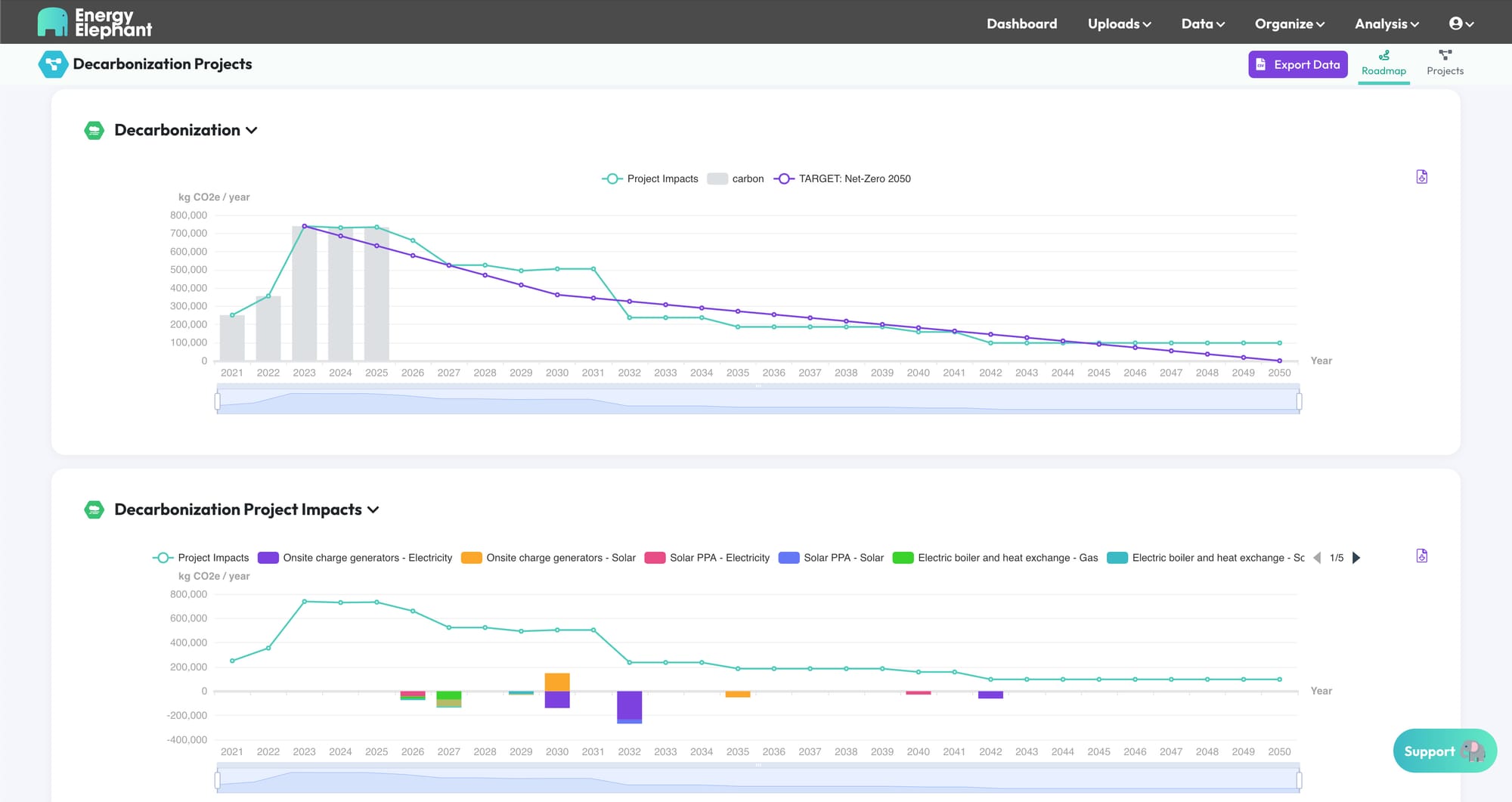
Headquartered in Dublin, Ireland, EnergyElephant provides an all-in-one platform for energy, waste, water, and carbon data management and reporting – across buildings, vehicles, and other assets. The platform enables organisations to establish baselines and benchmarks, set sustainability targets, monitor energy performance and carbon and GHG emissions, and manage decarbonisation initiatives through asset-level project planning and tracking.
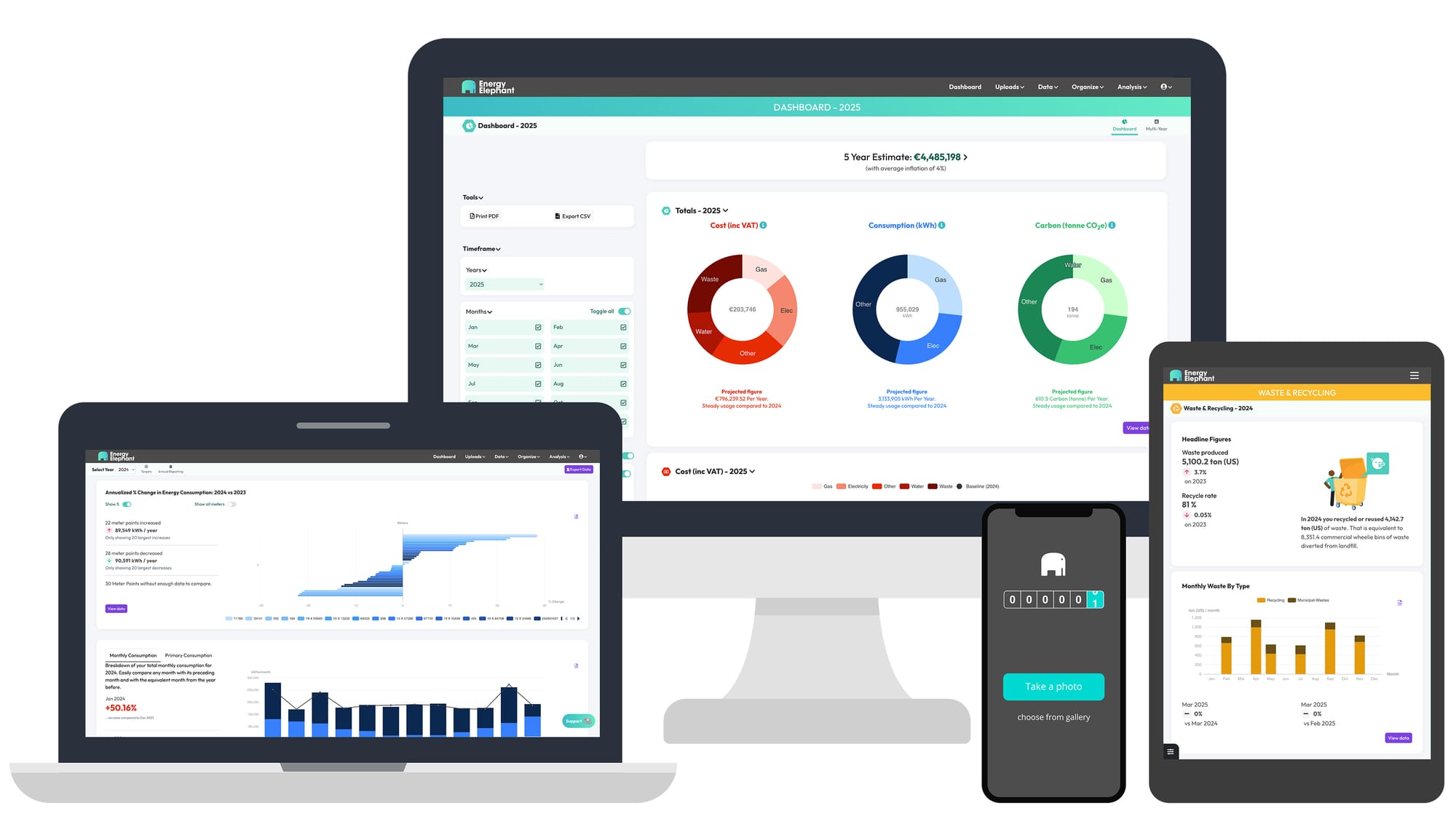
The system automates the collection, validation, storage, and analysis of data from utility bills, invoices, smart meters, sub-meters, IoT sensors, transport fuels, waste streams, water consumption, and other operational sources. It supports multi-country/currency utility bill/invoice collection and validation, recurring imports, and real-time data feeds where available. Configurable dashboards and analytics provide live visibility of energy consumption and performance. The system also supports budget forecasting, carbon pricing and offset modelling, payback analysis, and audit-ready reporting aligned with leading sustainability, energy, carbon, and ESG frameworks.
The company’s wider innovation ecosystem adds further value. The EnergyElephant meter-reading mobile app, used in more than 80 countries, makes manual data capture faster and more reliable, reducing reliance on estimated billing. And an open-source Smart Energy Traffic Light System helps organisations schedule energy-intensive activities when grid electricity is cleaner.
Core platform capabilities
- Utility and resource data ingestion: Upload thousands of energy, fuel, water, and waste bills or invoices in formats such as PDF, CSV, Excel, EDI, and XML; supports automated import workflows for ongoing data capture.
- Multi‑resource performance tracking: Track energy use, carbon emissions, waste generation, and water consumption across sites and assets to build a holistic view of environmental impact.
- Real‑time data and IoT integration: Connect with IoT sensors and sub‑metering systems to enhance visibility into live energy performance where data flows are available.
- Carbon emissions accounting: Support for Scope 1, Scope 2, and Scope 3 calculations using best‑in‑class methodologies based on actual consumption and real-time grid emissions factors.
- Audit‑ready reporting: Built‑in reports align with international standards and frameworks such as B Corp, CDP, CSRD, Energy Star, ERIC, GRESB, GHG Protocol, ISO 14001, ISO 50001, SBTi, SECR, VSME, and more, easing compliance and disclosure workflows.
- Decarbonisation planning tools: Visual tools to model energy performance, set reduction targets, compare building efficiency, assess costs/savings via Marginal Abatement Cost Curves, and track decarbonisation project progress.
Reporting, compliance, and insights
EnergyElephant’s platform emphasises audit‑ready reporting and compliance insight, giving organisations confidence in their emissions and ESG disclosures. Users can export custom reports for stakeholders or regulatory submissions while tracking KPIs on performance dashboards.
Considerations
- Feature onboarding: Organisations new to comprehensive energy and carbon platforms may need time and support to get up to speed with advanced analytics and planning tools.
- Scope of use: While highly effective for energy and emissions workflows, larger enterprises should assess integration pathways with existing BMS or ERP systems for real‑time data capture.
Who it’s ideal for
Designed for large companies, SMEs, and multi‑site organisations, the system is practical, scalable, and easy for both technical and non-technical teams to adopt. Role-based access controls support collaboration across business units while maintaining governance and auditability.
It best serves CFOs and Finance teams looking to link energy efficiency or carbon reductions to cost savings; ESG Managers and Sustainability teams striving to meet ambitious net‑zero and reporting goals; Head of Estates and Operations teams seeking smarter building management strategies; and Energy Managers and Facilities teams aiming to optimise performance and reduce emissions.
Business sectors supported to date include: banking and finance; healthcare and hospitals; real estate and hotels; retail and franchises; tech and multinationals; transport and logistics; universities and schools; and many public sector bodies.
Customers consistently report rapid deployment, dramatic reductions in data management time, significant cost savings, improved energy efficiency, substantial emissions reductions, and ease of reporting across diverse frameworks.
2. EnergyCAP
Headquartered in Pennsylvania, USA, EnergyCAP offers a modular solution that includes various interconnected components – such as UtilityManagement, SmartAnalytics, and CarbonHub – which enable users to manage energy, costs, and carbon emissions data from the portfolio level down to the asset and device level in a single platform.
Core platform capabilities
- Energy and utility bill management: UtilityManagement centralises utility bills and automates bill capture, validation, and accruals, helping organisations uncover errors, streamline workflows, and produce audit-ready data for both energy and financial teams.
- Energy data insights and analytics: The platform integrates interval consumption data, benchmarking, and real-time analytics, enabling users to identify energy trends, anomalous usage, and opportunities for efficiency improvements.
- Carbon accounting and reporting: CarbonHub automatically converts utility and energy data into Scope 1, Scope 2, and Scope 3, supporting compliance and decarbonisation planning with dashboards and reporting tools.
- Interconnected data workflows: SmartAnalytics enhances utility and emissions data with machine learning-assisted insights, real-time anomaly detection, and formula-based analytics that bridge the gap between billing and operational energy data.
Reporting, compliance, and insights
EnergyCAP provides dynamic dashboards and reports that help organisations communicate energy performance and emissions outcomes to internal and external stakeholders. Its reporting tools support benchmarking, Energy Star integration, management of GHG factors – including custom and market-based factors – and tracking of emissions progress over time. Dashboards and visualisations can be shared publicly or embedded for stakeholder transparency, and reports are designed to align with audit and compliance needs.
Considerations
- Complexity and learning curve: Some user reviews note that the platform’s depth and breadth of features can require significant onboarding and training for new users to become comfortable with all capabilities.
- Reporting flexibility: While reporting is powerful and comprehensive, some users have highlighted limited customisation options for certain reports without exporting data externally.
Who it’s ideal for
EnergyCAP is a strong fit for organisations that require finance-grade utility bill management, advanced energy analytics, and integrated carbon reporting across large portfolios of facilities. It is especially well-suited to enterprises and public sector organisations that manage complex utility data sets and need to reconcile energy, cost, and sustainability information in one place.
EnergyCAP vs EnergyElephant
EnergyCAP excels at finance-grade utility bill management, portfolio-level analytics, and audit-ready reporting.
EnergyElephant combines energy, waste, water, and carbon data management and reporting – across buildings, vehicles, and assets – with more interactive and visually oriented decarbonisation planning tools, making it especially valuable for organisations balancing both operational performance and emissions reduction strategies.
3. Watershed
Headquartered in California, USA, Watershed is an enterprise sustainability and climate platform that enables organisations to measure, report, and reduce their environmental impact, with a strong emphasis on carbon accounting, regulatory compliance, and strategic decarbonisation planning.
Watershed focuses on helping organisations build audit-grade carbon inventories and meet evolving global disclosure requirements such as CDP, CSRD, TCFD, and other major frameworks. It integrates with diverse data sources – including ERP systems, expense management tools, and utility providers – to automate data collection and ensure high-quality emissions data for Scope 1, Scope 2, and Scope 3 reporting.
Beyond measurement and reporting, Watershed supports decisions and action planning by enabling scenario modelling, target setting, and tracking progress toward decarbonisation goals. The platform also includes access to a marketplace of vetted carbon removal projects and clean energy opportunities that organisations can use to accelerate emissions reductions.
Core platform capabilities
- Comprehensive carbon measurement: Automated data ingestion with integrations and extensive emissions factor libraries for accurate Scope 1–3 footprints.
- Regulatory reporting and compliance: Tools to support ESG disclosures aligned with major frameworks and standards.
- Decarbonisation planning: Scenario modelling and emissions reduction pathways to inform strategic decisions.
- Expanded environmental data: Support for water and waste metrics alongside carbon data within the same platform.
- Carbon removal marketplace: Access to high‑quality carbon removal and clean energy project options.
Reporting, compliance, and insights
Watershed produces audit‑grade sustainability and carbon data that helps organisations prepare and file disclosures with confidence. This includes dynamic dashboards, benchmarking, trend analysis, and built‑in reporting for compliance needs across global regulatory landscapes.
Considerations
- Enterprise pricing: Watershed’s advanced capabilities and enterprise focus typically come with a premium price point, which may be less accessible to smaller organisations.
- Implementation visibility: Pre‑purchase information on implementation timelines and onboarding commitments can be limited publicly, making planning and comparison challenging.
Who it’s ideal for
Watershed is best suited to large enterprises that require robust, audit‑ready carbon accounting, comprehensive sustainability reporting, and strategic decarbonisation planning at scale. Its depth and range of integrations make it particularly valuable for organisations navigating complex regulatory environments and global operations.
Watershed vs EnergyElephant
Watershed is highly focused on enterprise‑grade carbon accounting, audit‑ready regulatory reporting, and decarbonisation pathways with scenario modelling and marketplace options for carbon removal. Although recognised by analysts as a leader in sustainability software, its enterprise‑level pricing may deter smaller organisations.
EnergyElephant could be a more cost-effective solution, combining energy, waste, water, and carbon data management and reporting – across buildings, vehicles, and assets – with strong visual decarbonisation planning tools tailored to operational energy and resource optimisation.
4. Spacewell Energy
Headquartered in Barcelona, Spain, Spacewell Energy (formerly Dexma) focuses on delivering real‑time energy intelligence to help organisations understand, optimise, and reduce their energy consumption. The platform is designed to support both operational energy teams and strategic sustainability goals through automated analytics, intuitive dashboards, and flexible reporting.
Spacewell Energy specialises in providing energy intelligence that combines real‑time monitoring, automated anomaly detection, and advanced analytics across large portfolios of buildings or assets. The platform translates high volumes of consumption data into actionable insights, enabling energy managers to improve efficiency, benchmark performance, and validate energy savings.
Core platform capabilities
- Real‑time energy monitoring and analytics: Track consumption across multiple sites and devices with intuitive, dynamic dashboards.
- Automated anomaly detection: AI‑driven detection of inefficiencies and irregularities to help pinpoint problems and prioritise corrective action.
- Measurement and verification tools: Validate energy savings and support performance tracking using advanced methodologies.
- Custom reporting and visualisation: Build tailored dashboards and automated reports to communicate energy performance and sustainability performance.
- Broad integrations: Connect with more than 200 types of hardware and systems – including BMS, SCADA, meters, and sensors – for unified data ingestion.
- Energy apps and extensibility: Expand capabilities via modular apps or custom tools using the platform’s API.
Reporting, compliance, and insights
Spacewell Energy enables energy reporting at both operational and stakeholder levels, with custom dashboards and automated report delivery that help organisations measure KPIs, communicate insights, and justify energy‑efficiency investments. Dashboards can be tailored to track consumption, cost, and carbon footprint metrics over time.
Considerations
- Implementation complexity: Some organisations find initial setup and configuration complex, particularly when connecting diverse data sources.
- Reporting customisation: Customisation limits on certain report visualisations have been noted, with some users exporting data for advanced analysis.
- Pricing considerations: Depending on scale, the platform may be expensive for smaller deployments.
Who it’s ideal for
Spacewell Energy is well suited for energy managers, consultants, ESCOs, utilities, and organisations focused on operational energy optimisation, real‑time performance tracking, and analytics‑driven decision‑making across multi‑site portfolios. Its strength in energy intelligence makes it a compelling choice for those prioritising operational efficiency and savings validation.
Spacewell Energy vs EnergyElephant
Spacewell Energy focuses on operational energy intelligence, emphasising real‑time monitoring, anomaly detection, measurement and verification of energy savings, and flexible reporting.
EnergyElephant delivers broader coverage for energy, waste, water, and carbon data management and reporting – across buildings, vehicles, and assets – alongside strong visual decarbonisation planning.
5. Measurabl
Headquartered in California, USA, Measurabl focuses on sustainability data management, ESG reporting, and real estate performance benchmarking, helping organisations centralise, verify, and report environmental data across portfolios. Its solutions are widely adopted in the real estate sector to support accurate disclosure, compliance, and decision‑making.
Measurabl helps organisations centralise sustainability and performance data from disparate sources – including utility bills, building metrics, water and waste data – to produce investment‑grade ESG insights and reports. The platform’s tools support tracking of energy, water, waste, and Scope 1–3 carbon emissions, with features to benchmark performance, identify anomalies, and set reduction targets.
Core platform capabilities
- Sustainability data management: Centralises and verifies environmental data to ensure quality and completeness for analysis and reporting.
- Benchmarking and portfolio insights: Compare performance against large real‑world datasets and industry benchmarks to uncover performance gaps and opportunities.
- Automated utility data collection: Collects and validates energy, water, waste, and other sustainability metrics automatically from multiple sources, reducing manual effort.
- ESG disclosure and reporting: Streamlines reporting to frameworks such as GRESB, CDP, TCFD, and others, with tools to generate stakeholder‑ready disclosures.
- Scenario and decarbonisation planning: Visualise performance trends, set targets, and assess the impact of actions across portfolios.
- Real‑time optimisation: With modules like Optimize, organisations can gain near‑real‑time visibility into performance, spotting anomalies and improving efficiency.
Reporting, compliance, and insights
Measurabl emphasises investment‑grade, audit‑ready sustainability data and supports flexible reporting across voluntary and mandatory frameworks. The platform’s data quality tools help ensure completeness and accuracy, enabling organisations to confidently disclose ESG performance to investors, regulators, and stakeholders.
Considerations
- Market focus: Measurabl is especially tailored for real estate portfolios, which means its depth in building‑level benchmarking and reporting may be stronger than generic energy management use cases.
- Learning curve: The breadth of ESG tools and reporting options can require onboarding support for new users to fully unlock advanced capabilities.
Who it’s ideal for
Measurabl is a strong choice for real estate owners, operators, and investors that need a centralised platform to manage sustainability performance, benchmark environmental metrics, and produce stakeholder‑ready ESG and carbon reports. It’s well suited for portfolios requiring rigorous compliance, benchmarking, and investment‑grade disclosures.
Measurabl vs EnergyElephant
Measurabl appears primarily tailored to the real estate sector, where it excels in benchmarking and investment‑grade portfolio insights.
EnergyElephant covers a broad range of sectors, combining energy, waste, water, and carbon data management and reporting – across buildings, vehicles, and assets – with strong interactive and visually oriented decarbonisation planning tools.
6. Sweep
Headquartered in Montpellier, France, Sweep enables organisations to track carbon and ESG data at scale, automating data collection and cleansing to reduce errors and manual work. The platform supports full coverage of Scope 1, Scope 2, and Scope 3, helping organisations understand their environmental impact across operations and supply chains. Users can monitor regulatory compliance, prepare audit‑ready disclosures, and build data‑driven sustainability strategies with real‑time insights and scenario modelling. Sweep offers deep forecasting, scenario analysis for decarbonisation, and granular action plans with CAPEX tracking. It also provides training through Sweep School.
Core platform capabilities
- Comprehensive emissions tracking: Automated Scope 1–3 carbon accounting with robust data governance and audit trails.
- Centralised sustainability data: Consolidate ESG information – including energy, carbon, water, and value‑chain metrics – into a single source of truth.
- Compliance and disclosure: Built‑in support for global frameworks such as GHG Protocol, CSRD, SFDR, ISSB, and GRI to streamline reporting and regulatory compliance.
- Value chain insights: Map emissions across suppliers and operational units to identify carbon hotspots and reduction opportunities.
- Data‑driven strategy and action: AI‑enabled recommendations and reduction pathway simulations help organisations prioritise sustainability actions.
- Audit‑ready controls: Traceable records, verification workflows, and structured documentation to support audit processes.
Reporting, compliance, and insights
Sweep delivers dynamic dashboards and real‑time reporting that helps organisations measure performance, visualise trends, and communicate sustainability outcomes to internal and external stakeholders. It aligns emissions data with regulatory and voluntary frameworks to support audit‑ready ESG disclosures.
Considerations
- Broader ESG focus: Sweep is designed as a sustainability and carbon reporting platform, which means it may be less specialised on operational energy management details compared to solutions focused on energy bill tracking and real‑time energy analytics.
- Implementation planning: Organisations should assess integration and data source requirements to ensure seamless value chain visibility across all relevant metrics.
Who it’s ideal for
Sweep is ideal for mid‑market to enterprise organisations aiming to streamline sustainability and carbon reporting, manage complex ESG data, meet evolving regulatory requirements, and build data‑driven decarbonisation strategies across their operations and value chains. Its automated carbon accounting and compliance features make it well suited for organisations preparing for CSRD, SFDR, ISSB, or similar frameworks.
Sweep vs EnergyElephant
Sweep excels in ESG compliance and strategic carbon insights, but there appears to be less emphasis on operational energy management and resource optimisation workflows.
EnergyElephant combines energy, waste, water, and carbon data management and reporting – across buildings, vehicles, and assets – making it especially valuable for organisations balancing both operational performance and emissions reduction strategies.
7. Deepki
Headquartered in Paris, France, Deepki helps organisations – particularly in real estate and asset‑intensive industries – centralise, analyse, report, and act on environmental performance data at scale. It enables users to track energy use, carbon emissions, compliance metrics, and broader sustainability indicators while supporting strategic decarbonisation and disclosure workflows.
Deepki provides a unified SaaS platform that brings together sustainability data, analytics, reporting, and decision support, helping organisations manage climate risk, improve asset performance, and meet regulatory and investor expectations. With hardware‑agnostic data ingestion and extensive automated connectors, the platform aggregates utility, energy, water, waste, and carbon data from across portfolios and integrates it into dashboards and reporting modules.
Core capabilities
- Automated sustainability data collection: Collect and centralise ESG metrics across energy, carbon, water, waste, and more to build a comprehensive performance database.
- Portfolio‑level benchmarking: Compare performance across assets and against industry standards to uncover inefficiencies and opportunities.
- Carbon accounting and reporting: Calculate Scope 1, Scope 2, and Scope 3 emissions, and support compliance with frameworks such as GHG Protocol, CSRD, and other regulatory standards.
- Audit‑ready reporting: Data governance, versioning, and audit logs make it easier to prepare and defend disclosures to regulators, investors, and auditors.
- Decarbonisation planning and insights: Tools to model carbon reduction scenarios, simulate investment impacts, and align energy and sustainability strategies with business goals.
- Visualisation and dashboards: Intuitive dashboards and performance visualisations help stakeholders track KPIs, energy use, and emissions trends across complex portfolios.
Reporting, compliance, and insights
Deepki’s platform supports audit‑ready sustainability disclosures that meet the evolving needs of regulators, investors, and internal stakeholders. It simplifies compliance with major frameworks by offering structured workflows for data preparation, verification, KPI exports, and submission‑ready reports.
Considerations
- Primarily real estate‑centric: Its strongest market and implementation depth are in real estate asset portfolios, which may make it less of a fit for organisations outside property or asset‑intensive sectors.
- Complex integrations: Enterprise‑scale ESG solutions often require detailed setup and integration across data sources, which can demand planning and technical resources.
Deepki vs EnergyElephant
Deepki is primarily oriented toward real estate and asset portfolios, delivering audit‑ready data, risk insights, and strategic decarbonisation planning.
EnergyElephant covers a broad range of sectors, combining energy, waste, water, and carbon data management and reporting – across buildings, vehicles, and assets – with strong visual decarbonisation planning tools, making it especially valuable for organisations balancing both resource optimisation workflows and emissions reduction strategies.
8. Workiva Carbon
Headquartered in Iowa, USA, Workiva Carbon (formerly Sustain.Life) is integrated into the broader Workiva reporting ecosystem, designed to help organisations measure, manage, and report GHG emissions at scale. The solution supports businesses in navigating evolving regulatory requirements and aligning environmental data with verified disclosures.
Workiva Carbon aims to simplify the full lifecycle of carbon management by automating data collection and calculations, guiding emissions reduction planning, and supporting audit‑ready sustainability disclosures across voluntary and mandatory frameworks.
Core platform capabilities
- Comprehensive emissions tracking: Automates calculation of Scope 1, Scope 2, and Scope 3 emissions, consolidating data from energy use, supply chains, and other business activities.
- Measure, manage, and report: Centralises environmental data and provides tools to build reduction plans, set science‑based targets, and streamline sustainability reporting.
- Scenario planning: Helps organisations simulate future emissions outcomes and assess climate risks as part of reduction strategies.
- Supply chain insights: Includes features to survey, score, and strengthen supplier sustainability performance to improve Scope 3 visibility.
- Compliance and disclosure support: Built‑in alignment with major frameworks such as GHG Protocol, CDP, and other ESG reporting standards, preparing organisations for regulatory reporting and investor‑grade disclosures.
- Carbon offset integration: Offers options to purchase high‑quality carbon credits to help balance unavoidable emissions.
Reporting, compliance, and insights
Workiva Carbon emphasises an audit‑ready approach to sustainability reporting, capturing data lineage and evidence needed to support disclosures that align with frameworks and regulatory requirements. By centralising data and automating calculations, the platform can reduce reliance on spreadsheets and manual processes.
Considerations
- Primarily carbon and ESG focused: Workiva Carbon’s strength is in emissions tracking and sustainability reporting rather than broader operational energy management workflows.
- Integration with broader reporting stack: Its value is maximised when paired with Workiva’s other reporting tools, especially for integrated financial and non‑financial disclosures.
- Data upload and management: Some users report opportunities for improved flexibility and bulk data editing.
Who it’s ideal for
Workiva Carbon is well suited for organisations prioritising carbon emissions tracking, ESG reporting, and compliance readiness – particularly those that benefit from integrating carbon data with financial and governance reporting in a unified platform. It caters to businesses needing audit‑ready sustainability disclosures and supply chain emissions insights.
Workiva Carbon vs EnergyElephant
Workiva Carbon focuses on carbon accounting, sustainability reporting, and compliance, rather than operational energy workflows. Its integration into Workiva’s reporting ecosystem enables unified financial and non‑financial reporting.
EnergyElephant combines energy, waste, water, and carbon data management and reporting – across buildings, vehicles, and assets – with strong visual and actionable decarbonisation planning tools, and built‑in reports aligned with international standards and frameworks. It enables organisations to balance both resource optimisation workflows and emissions reduction strategies, to meet both internal targets and external compliance requirements.
9. IBM Envizi
Headquartered in Sydney, Australia, IBM Envizi is designed to help organisations centralise, analyse, report, and act on environmental performance data at scale. It combines robust data capture, AI‑enhanced analytics, decarbonisation tools, and compliance‑ready reporting to support strategic decision‑making and regulatory disclosures.
IBM Envizi provides a unified system of record for sustainability and ESG data, automating the capture and consolidation of diverse data types into a central platform to underpin emissions calculations, performance analysis, and reporting. It supports environmental data from across operations – including energy use, utilities, supply chain inputs, and more – to create a single source of truth for sustainability and climate performance.
The modular ESG Suite is designed to scale with organisational needs, enabling both high‑level enterprise reporting and granular analysis for specific business units or assets, with support for AI‑driven planning, forecasting, and scenario modelling to inform decarbonisation strategies.
Core platform capabilities
- Comprehensive emissions tracking: Automates Scope 1, Scope 2, and Scope 3 emissions accounting using GHG Protocol‑aligned calculation engines, including NLP‑assisted categorisation of spend data for more efficient Scope 3 analysis.
- ESG data management and consolidation: Centralises and normalises multi‑source data into a single authoritative system to reduce manual effort and improve accuracy.
- Audit‑ready reporting: Built‑in workflows, evidence trails, and data governance tools help organisations generate compliance and disclosure reports across frameworks like CSRD, GRI, SASB, TCFD, SFDR, and others.
- Decarbonisation and planning tools: Scenario modelling, performance forecasting, and project prioritisation tools provide actionable insights to support emissions reduction strategies.
- Portfolio insights and analytics: Dashboards and visualisation tools enable users to understand sustainability performance across business units, facilities, or value chains.
Reporting, compliance, and insights
IBM Envizi emphasises audit‑ready ESG and carbon reporting, enabling organisations to meet internal and external disclosure requirements with confidence by providing transparent data lineage and analytics embedded within the platform. Support for major global reporting standards and templates helps reduce manual reporting tasks and streamline sustainability disclosures.
Considerations
- Enterprise focus: IBM Envizi’s comprehensive feature set and integration with IBM’s broader sustainability stack make it a strong choice for larger organisations with complex data needs, but potentially costly or complex to implement for smaller teams.
- Setup and training: Some users note a steeper learning curve and investment in onboarding to fully leverage advanced analytics and reporting workflows.
Who it’s ideal for
IBM Envizi is well suited for large enterprises seeking a robust, audit‑ready sustainability management platform that consolidates ESG data, supports comprehensive regulatory reporting, and provides advanced planning tools to drive decarbonisation and performance improvement. Its capabilities make it particularly appealing for organisations with complex data landscapes or global reporting obligations.
IBM Envizi vs EnergyElephant
IBM Envizi appears oriented toward enterprise‑grade ESG data management, ideal for organisations with complex global portfolios and rigorous disclosure needs. Higher complexity and enterprise‑level pricing may, however, deter smaller organisations.
EnergyElephant appears to be a more cost-effective solution, combining energy, waste, water, and carbon data management and reporting – across buildings, vehicles, and assets. With strong visual and actionable decarbonisation planning tools, and built‑in reports aligned with a wide range of international standards and frameworks, it is especially valuable for organisations balancing both operational performance and emissions reduction strategies to meet compliance requirements.
Tips for evaluating similar product offerings
- Focus on the MVP: Ask vendors to demonstrate a Minimum Viable Product (MVP) tailored to your core needs. This allows you to quickly assess the software's functionality, usability, and alignment with your specific requirements without a significant upfront investment.
- Iterative evaluation: Ask vendors to showcase their development process and how they incorporate user feedback. Look for a commitment to ongoing improvement and iteration based on user input. This ensures the software evolves to meet your changing needs and incorporates valuable features over time.
- Prioritise value: Instead of solely focusing on a comprehensive feature set, clearly define the core value you seek from the software. Evaluate vendors based on their ability to deliver that value efficiently and effectively, even if it means starting with a simpler solution with stronger support. This helps avoid feature bloat and ensures the software directly addresses your critical business challenges.
- Testing and validation: Request trials or demos that allow you to test the software with real-world scenarios relevant to your business. This provides valuable insights into the software's performance, usability, and ability to deliver the promised value.
- Transparency and feedback: Prioritise vendors who are transparent about their development process, limitations, and future roadmap. Look for vendors who actively solicit and incorporate user feedback, demonstrating their commitment to continuous improvement and customer satisfaction. This approach aligns with the lean start-up methodology of ‘validated learning’, ensuring the chosen software evolves to meet your needs over time.
Bonus Resource
To help you streamline the vendor shortlisting / selection process, we’ve put together a sample list of ~80 questions for you to ask (and what to look for in a response), so you can save time and effort by quickly eliminating software providers that can’t meet your specific requirements.